
Levitra vs. Viagra: Vardenafil and Sildenafil Compared

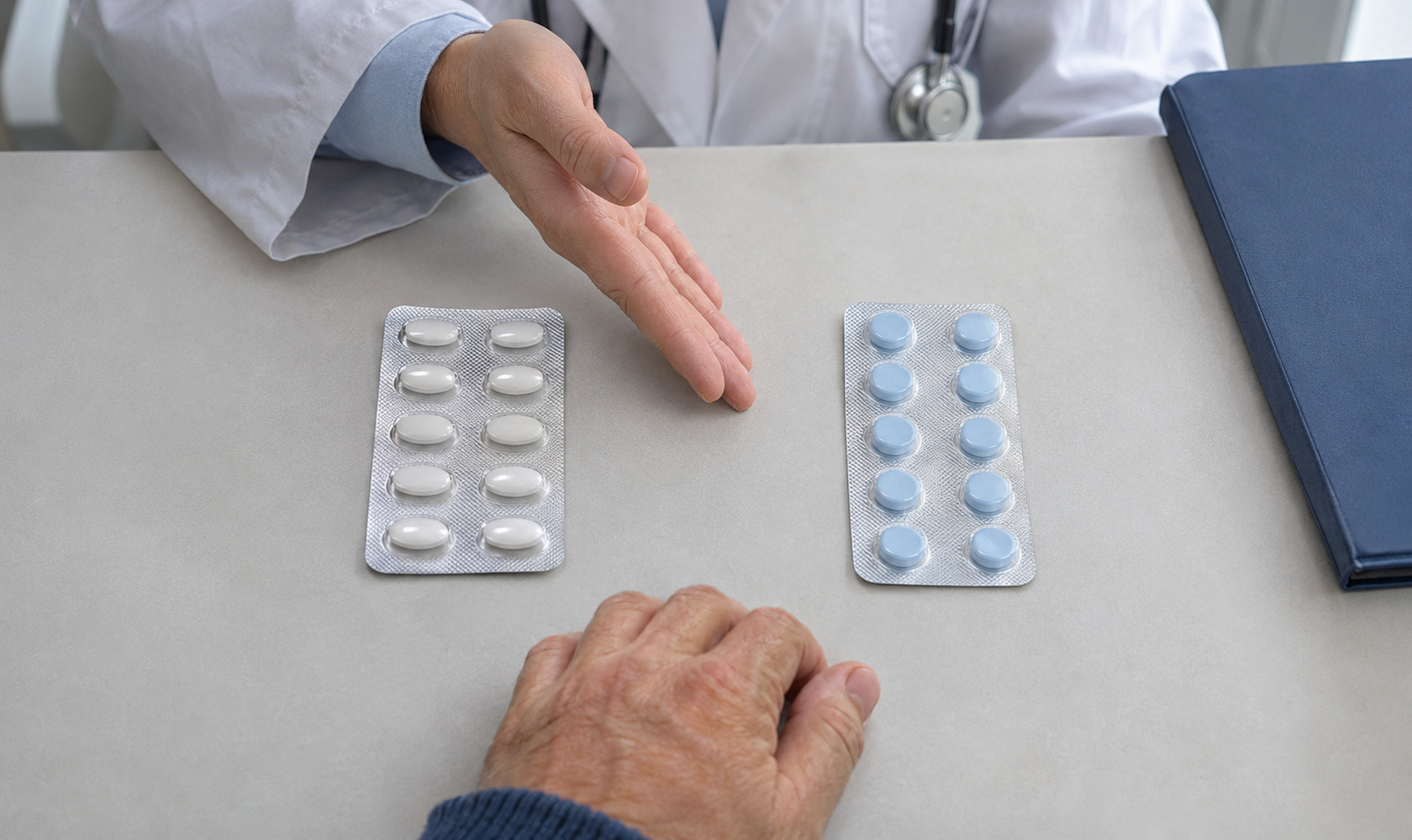
Vardenafil and sildenafil both treat erectile dysfunction by supporting blood flow during sexual stimulation. Their timing and duration overlap, so the choice often turns on individual response, adverse effects, interactions, and the practical details of the prescription.
Levitra contained vardenafil. Viagra contains sildenafil, which also comes as an approved generic. The discontinued U.S. Levitra brand does not mean that generic vardenafil lacks an established role in treatment. It also does not make a familiar brand name more useful than the active ingredient when comparing prescriptions.
A clinician can use the differences to choose an initial treatment, but no comparison table can predict exactly which medicine will suit one patient. A trial with clear instructions and a follow-up often provides more useful information than searching for a universal winner.
Start with the problem you want treatment to solve
ED can involve difficulty becoming firm, losing firmness during activity, or inconsistent erections in particular circumstances. Diabetes, vascular disease, nerve damage, medication effects, and psychological factors can all contribute. More than one cause may operate at the same time.
Low desire, pain, delayed orgasm, and premature ejaculation are related sexual concerns, but they are not interchangeable with an erection problem. Tell the clinician which part of the experience is difficult. A medicine that improves penile blood flow may not address the main concern if it involves desire or pain.
The assessment also provides an opportunity to review blood pressure, diabetes, smoking, cholesterol, and cardiovascular symptoms. Treating ED does not replace treatment of those conditions. A new erection problem can justify a broader health discussion even when the immediate goal concerns sex.
How both medicines work
Sexual stimulation sends signals through the nervous system and promotes nitric oxide release in the penis. The resulting increase in cGMP relaxes smooth muscle and allows more blood to enter the corpora cavernosa, the paired erectile chambers.
As those chambers expand, surrounding structures help compress the veins that would otherwise carry blood away. This combination of inflow and restricted outflow produces firmness. When stimulation ends and the signaling changes, blood can leave and the erection subsides.
Phosphodiesterase type 5, or PDE5, breaks down cGMP. Sildenafil and vardenafil inhibit that enzyme and help the signal persist. They support arousal rather than creating it, and they do not enlarge the penis permanently.
The FDA first approved sildenafil as Viagra for ED in 1998 and vardenafil as Levitra in 2003. Sildenafil also has a separate role in pulmonary arterial hypertension through other products and regimens. Vardenafil's approved indication is ED; a pulmonary hypertension dosing schedule should not transfer to an erection prescription.
Timing and duration at a glance
| Feature | Vardenafil | Sildenafil |
|---|---|---|
| Usual conventional-tablet starting amount | 10 mg for many adults after assessment. | 50 mg for many adults after assessment. |
| Planning before sex | Approximately one hour. | Commonly about one hour, with labeled use approximately 30 minutes to four hours before sex. |
| Average half-life | Approximately four to five hours. | Approximately four hours. |
| Typical clinical pattern | On-demand support over several hours. | On-demand support over several hours. |
| Meal considerations | A moderate meal generally has less effect than a very fatty meal. | A high-fat meal can delay absorption and the early response. |
| Distinct warning to discuss | Congenital long QT syndrome and certain antiarrhythmics. | Its own interactions, clearance factors, and visual precautions still need review. |
These figures describe general prescribing information, not instructions for changing treatment. Lower doses or longer intervals may apply with age, organ impairment, or interacting medicines. Different formulations of the same ingredient can also carry different instructions.
Does vardenafil last longer?
The average half-life of vardenafil is slightly longer than that of sildenafil, but this does not create a dependable extra number of hours for every patient. Half-life describes the fall in blood concentration; the period of useful erection support depends on exposure, stimulation, and the individual response.
Some vardenafil research has tested a later window. A randomized study of 383 men evaluated sex about eight hours after dosing and found better penetration and successful-intercourse outcomes than placebo. That supports a potential extended response in selected patients, not a guaranteed eight-hour effect after every tablet.
Sildenafil trials also show that benefit can remain several hours after a dose. Many men notice the effect fading around three to four hours, but the medicine does not vanish at a fixed deadline. A fading response does not authorize another dose.
Neither medicine should produce an erection that persists for the whole treatment window. An erection lasting more than four hours requires emergency care even without pain. Normal erections can begin and end more than once as stimulation changes, and a recovery period after orgasm can still occur.
If a short on-demand window creates too much pressure, ask about a different treatment plan. Tadalafil can offer potential benefit up to 36 hours and a low-dose daily option for eligible patients, but switching requires instructions rather than overlap with the existing medicine.
Which starts working sooner?
Both conventional sildenafil and vardenafil tablets commonly require planning rather than immediate use at the moment intercourse begins. A clinician often advises taking the prescribed amount about an hour beforehand. Some men respond earlier, while others need more time.
Onset studies can report early responders under specific conditions, including controlled stimulation and formulation-specific testing. An early response in a study does not guarantee the same timing after a heavy dinner or establish that another tablet is necessary when an attempt at fifteen minutes fails.
Chewable, dissolving, or compounded products need their own assessment. Do not apply a commercial claim about one formulation to every tablet containing the same drug. Ask which evidence and administration instructions apply to the actual product dispensed.
Meals can change the early response
Both medicines can accompany food under their labeling, but food can change absorption. A large high-fat meal can delay sildenafil's onset. A patient who took the medicine after dinner may incorrectly conclude that the dose is inadequate when it simply needs more time.
A crossover study in 25 healthy men examined vardenafil after fasting, a high-fat breakfast, and a moderate-fat evening meal. The high-fat breakfast delayed the median time to peak concentration from about one hour to two hours, while the moderate evening meal had no clinically relevant effect on pharmacokinetics in that study.
This distinction explains why conventional vardenafil may fit an ordinary dinner schedule for some patients. It does not mean every meal leaves its timing unchanged or that sildenafil must always be taken without food.
If meals repeatedly interfere with the plan, discuss timing, meal composition, or another prescription. Do not redose to compensate. The original tablet can still absorb later and create excessive exposure when an additional tablet follows it.
What effectiveness studies can and cannot compare
Both medicines have outperformed placebo in ED trials. The studies often assess different questions: whether penetration occurred, whether an erection lasted through intercourse, whether the patient perceived improvement, or whether treatment improved questionnaire scores.
In a North American vardenafil trial, the 20 mg group reported a penetration success rate of about 80 percent compared with 52 percent on placebo at three months. The corresponding per-patient rate of maintaining the erection to successful intercourse was about 65 percent versus 32 percent. Those percentages refer to specific encounter outcomes, not a promise that 80 percent of all patients will have the same experience.
Sildenafil studies also show improvements over placebo across several strengths. Long-term reports have described high rates of perceived improvement among participants continuing treatment. The population remaining in a longer study can differ from everyone who initially tried the medicine, so persistence and selection matter.
It is not sound to compare an improvement percentage from one sildenafil study with a penetration percentage from a separate vardenafil study and declare a winner. Dose, baseline severity, health conditions, follow-up, and the outcome definition can all differ.
A clinical response can also change with use. Clear instructions about timing and stimulation can improve an apparent failure. Persistent problems may require a health review, a dose adjustment, another drug, or a nonoral approach.
Doses do not convert milligram for milligram
Conventional vardenafil often starts at 10 mg, with possible reduction to 5 mg or increase to 20 mg. Selected circumstances require 2.5 mg or a longer interval. The 20 mg strength is the maximum recommended conventional-tablet ED dose, not the routine target for every man.
Sildenafil commonly starts at 50 mg, with adjustment to 25 mg or 100 mg according to response and risk. The maximum recommended ED dose is 100 mg. Some 20 mg sildenafil formulations come from pulmonary hypertension treatment and may appear in off-label ED prescriptions with explicit tablet-count instructions.
A lower milligram number does not mean vardenafil is weaker. Different compounds require different amounts to produce their clinical effects. Likewise, a younger patient does not automatically need a low dose, and severe ED does not automatically justify the maximum.
Age, liver or kidney function, blood pressure, interacting medicines, and previous adverse effects influence the decision. Ask about tablet splitting before attempting it, and do not assume that a dissolving vardenafil product is interchangeable with a conventional tablet.
Comparing adverse effects
Headache, flushing, nasal congestion, indigestion, nausea, dizziness, and back or muscle discomfort can occur with PDE5 inhibitors. Some patients notice temporary visual changes, including altered color perception. The pattern and frequency can differ with dose and individual susceptibility.
Side effects can start at different times and may continue after erection support becomes less noticeable. They do not have to begin exactly two or three hours after a tablet. Record the actual pattern rather than relying on an assumed timetable.
A reaction to one drug does not guarantee the same result with the other, but switching cannot promise freedom from a class-related effect. A lower dose may also improve tolerability without losing enough benefit to matter. Discuss recurring symptoms before abandoning treatment or increasing the amount.
Sudden vision loss and sudden decrease or loss of hearing require immediate medical attention and stopping the medicine until assessment. A four-hour erection requires emergency treatment. Severe allergic symptoms, chest pain, collapse, and serious breathlessness also need urgent care.
The vardenafil QT warning
Vardenafil can affect the QT interval, part of the heart's electrical cycle. People with congenital long QT syndrome or those taking class IA or III antiarrhythmic medicines should avoid it. Tell the clinician about rhythm disorders, unexplained fainting, and a family history of long QT syndrome.
Other medicines, including some antibiotics, can also affect cardiac electrical activity. The prescriber needs the full list rather than a statement that you have a minor rhythm problem. The exact diagnosis and treatment determine the concern.
Sildenafil does not carry the same vardenafil-specific QT precaution, but that does not make self-substitution safe. A patient with a rhythm disorder still needs review of cardiovascular stability, interacting medicines, and the safety of sexual activity.
Shared interaction rules
Neither drug may combine with nitrates such as nitroglycerin or isosorbide products, recreational nitrites called poppers, or guanylate cyclase stimulators such as riociguat. These combinations can cause dangerous blood pressure reductions.
Alpha-blockers and other antihypertensives require individualized review. They do not all create an absolute prohibition, and a supervised plan may be possible. Do not stop those medicines independently or decide that a smaller ED tablet solves the issue.
Some antifungals, antibiotics, HIV treatments, and other enzyme inhibitors can raise drug exposure. Adjustment rules differ between sildenafil, conventional vardenafil, and orally disintegrating vardenafil. A direction that applies to one cannot automatically transfer to another.
Grapefruit can affect metabolism, while alcohol can worsen dizziness and erections, especially in larger amounts. Do not add enhancement supplements or another ED prescription. The absence of an ingredient on a supplement label does not verify that the product contains no prescription drug.
If chest pain develops after an ED dose, stop sexual activity and obtain medical help. Tell emergency clinicians the medicine, amount, and time taken. Do not self-administer a nitrate; the treating team must choose care with the interaction in mind.
Cost and availability
The manufacturer discontinued U.S. Levitra products, and the FDA determined that the reviewed strengths had not left the market for safety or effectiveness reasons. Generic vardenafil remains the practical ingredient to discuss with a pharmacy. Sildenafil also has approved generic options.
Compare the exact prescribed strength, formulation, quantity, and total price. Insurance restrictions, discounts, consultation fees, delivery, and recurring charges can change the cost per use. Old brand-price examples do not establish what a current prescription will cost.
Do not choose an excessive strength solely because its unit price looks lower, or order a large supply before knowing whether the treatment suits you. A pharmacy can verify availability and help clarify whether a proposed substitution matches the prescription.
Make the follow-up specific
Record when you took the dose, what you ate, alcohol intake, stimulation, erection quality, and symptoms. Tell the clinician whether timing created pressure and whether benefit lasted long enough for the intended activity. These details make a comparison between treatments more useful.
If an appropriate trial fails, ask about another oral medicine, a vacuum device, counseling, alprostadil, or specialist treatment. Confirm when the old medicine stops and the replacement starts so two prescriptions do not overlap unintentionally.
When both oral options need a different approach
A patient who cannot take PDE5 inhibitors because of a nitrate prescription needs more than a comparison between sildenafil and vardenafil. The clinician can discuss a vacuum erection device, which uses negative pressure to draw blood into the penis, and explain safe use of any accompanying constriction ring.
Alprostadil offers another route through an injection or an appropriate local formulation. It requires instructions about administration, dose, and prolonged-erection risk. A penile implant assessment may suit selected patients after other options fail or prove unsuitable. These choices involve different tradeoffs from an oral tablet.
Counseling can help when performance anxiety, relationship conflict, depression, or fear after a previous unsuccessful attempt interferes with arousal. It can accompany treatment for vascular or nerve-related ED rather than requiring a choice between a physical and a psychological explanation.
Do not stop an antidepressant, antihypertensive, or another necessary medicine because it might contribute to ED. The prescriber can review alternatives or adjustments while continuing treatment for the condition that led to the original prescription.
Questions to ask before switching
What exactly counts as an adequate trial? Agree on timing, stimulation, appropriate attempts, and how to report the result. One rushed attempt after a large meal may not provide enough information, while persistent difficulty despite appropriate use deserves a broader review.
Which symptoms should stop the trial? Establish the difference between a tolerability issue for a routine call and an emergency such as a four-hour erection, sudden sight loss, or chest symptoms. Do not continue repeated doses to test a suspected serious reaction.
What happens to the old tablets? Keep clear instructions about when the previous prescription ends, whether it should remain available, and when the replacement starts. A patient who keeps two packages without a current plan can accidentally overlap treatments.
How will cost and supply affect follow-up? Confirm the pharmacy can obtain the prescribed formulation and ask whether a smaller initial supply makes sense before buying a larger quantity. A price advantage does not help if the medicine cannot be tolerated or the label remains unclear.
What should a partner expect? Explain that the tablet supports arousal and does not promise an erection on command, remove a normal recovery period, or solve every issue with desire and orgasm. Shared expectations can reduce pressure while the patient and clinician assess treatment.
After prostate surgery or another treatment affecting pelvic nerves, the cause of ED and recovery timeline may differ from the populations in general trials. Tell the specialist about the operation and current recovery plan before using a trial percentage to judge your own progress.
Sources
- DailyMed: vardenafil prescribing information. https://dailymed.nlm.nih.gov/dailymed/drugInfo.cfm?setid=31be68b0-ac7e-42d0-9435-1f0a329b63d8
- MedlinePlus: vardenafil. https://medlineplus.gov/druginfo/meds/a603035.html
- DailyMed: sildenafil prescribing information. https://dailymed.nlm.nih.gov/dailymed/drugInfo.cfm?setid=d905dc8d-917f-4ea3-a4ee-a1ecf6967d4e
- Rajagopalan and colleagues: meal effects on vardenafil exposure. https://pubmed.ncbi.nlm.nih.gov/12638394/
- Porst and colleagues: response eight hours after dosing. https://pubmed.ncbi.nlm.nih.gov/16820261/
Related reading
- Levitra vs. Cialis: Vardenafil and Tadalafil Compared
- Sildenafil: Uses, Timing, Safety and Treatment Options
- Is Sildenafil Safe? Health Conditions, Interactions and Precautions
- Sildenafil and Viagra Side Effects: What to Expect and When to Act
- Sildenafil Interactions: Medicines, Food and Alcohol
- Erectile dysfunction treatment options
Medical Disclaimer: This content is provided for informational and educational purposes only and does not constitute personalized medical advice, diagnosis, or treatment. Always consult a qualified physician or licensed healthcare provider with any questions regarding a medical condition or prescription medication. Read our Editorial & Medical Review Policy.