
How Long Does Cialis Last? Onset, Half-Life and Daily Treatment

Cialis can improve erectile response for up to 36 hours after an as-needed dose. That window does not mean a continuous erection or a guaranteed response for the entire period. Tadalafil supports erections when sexual stimulation occurs, and individual benefit varies.
Distinguish the timelines. Onset describes when benefit may begin, duration describes the opportunity for effect, and half-life describes how quickly drug concentration falls. None of those numbers alone tells you when an interacting medicine becomes safe.
The difference between onset and duration
Some patients notice benefit within about 30 minutes. Others find that a longer lead time works better. The standard tablet can reach peak blood concentrations across a broad interval, commonly around two hours on average, with reported values extending from about 30 minutes to six hours.
You do not need a precise peak concentration to experience a benefit, and you should not expect an erection simply because enough minutes have passed. Sexual stimulation starts the process that tadalafil supports.
The up-to-36-hour duration comes from improved erectile response observed after on-demand dosing. It gives a wider opportunity for sex than several shorter-acting alternatives. The useful window for a particular person may be shorter, and a response late in the window may differ from an earlier one.
Do not treat a report of benefit beyond that period as a dependable 72-hour prescription. Individual accounts or selected study observations cannot guarantee three days of effect or establish an appropriate redosing schedule.
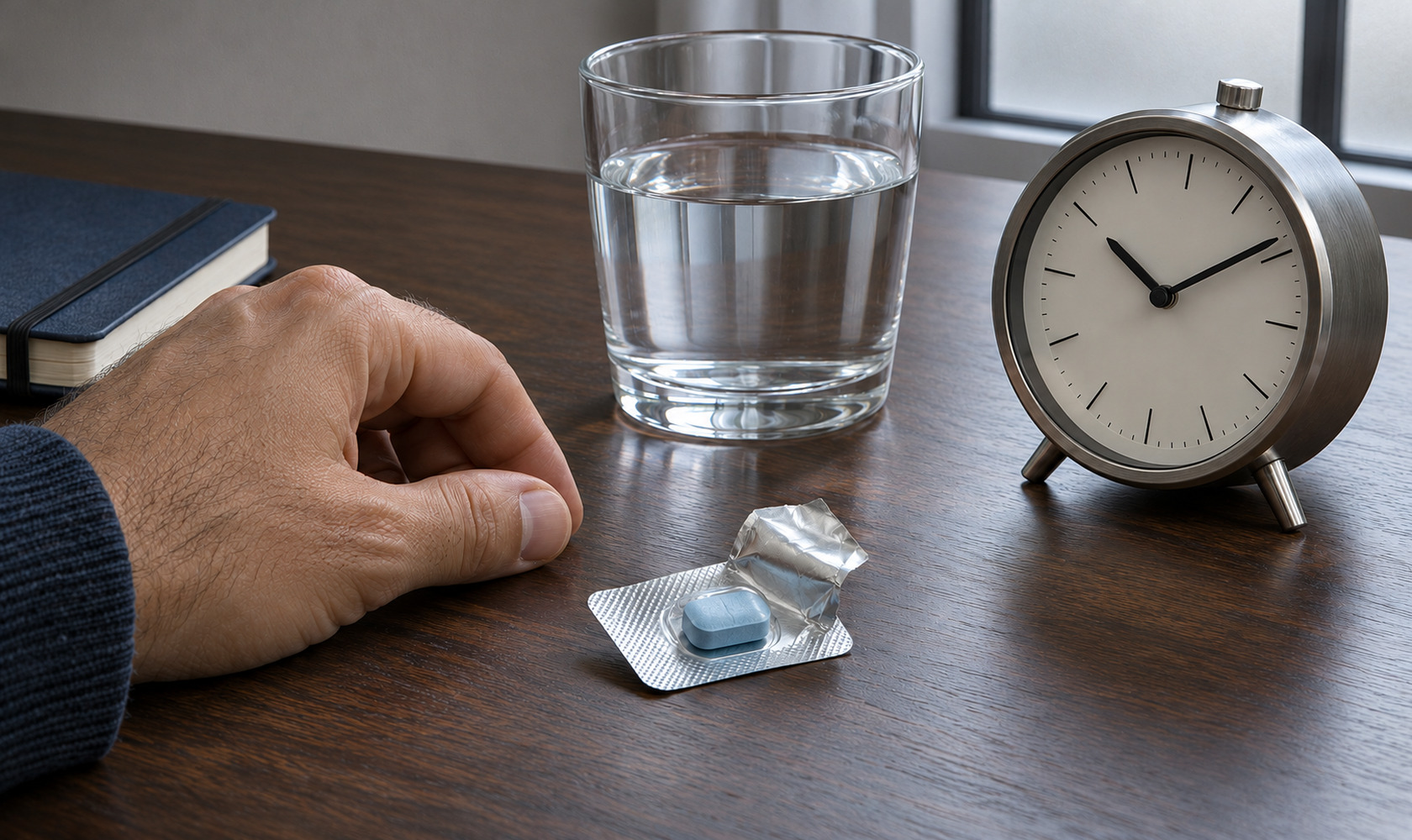
What the 17.5-hour half-life means
Tadalafil's average terminal half-life in healthy adults is about 17.5 hours. In simplified terms, half of the relevant drug exposure remains after one half-life, then half of that amount after another, as elimination continues.
| Simplified elapsed time | Approximate fraction remaining under a constant half-life model |
|---|---|
| One half-life, about 17.5 hours | One-half |
| Two half-lives, about 35 hours | One-quarter |
| Three half-lives, about 52.5 hours | One-eighth |
| Four half-lives, about 70 hours | One-sixteenth |
This model explains why the body does not reset when the perceived sexual effect fades. It does not predict an individual's exact concentration or a safe time for another medicine. Kidney function, other drugs, age-related factors, and repeated dosing can change the picture.
Half-life also differs from useful erection support. A small residual amount can remain after the drug no longer provides the same benefit. Conversely, a person may notice benefit without waiting until the highest blood concentration.
Daily dosing creates a different pattern
Daily ED treatment commonly uses 2.5 mg or 5 mg, while on-demand treatment commonly uses 5 mg to 20 mg under the prescription. Repeated daily doses maintain ongoing exposure rather than relying on a larger tablet before each encounter.
It commonly takes about five days to reach steady-state concentrations. At that point, regular dosing and elimination produce a repeating pattern. This does not mean the drug remains at an identical level every minute or guarantees an erection whenever wanted.
Take the daily dose at approximately the same time, independent of sexual activity. Do not add an on-demand tablet because sex occurs later in the day. A lower daily tablet still contributes active drug when another dose arrives.
If you change between daily and on-demand use, ask for transition instructions. A new schedule should replace or deliberately modify the old one rather than leave both prescriptions active through misunderstanding.
Does 20 mg last longer than a lower dose?
Dose affects exposure, and a higher amount may provide a more noticeable response for some patients. It does not produce a reliable hour-for-hour extension or guarantee that every person receives the full 36-hour window.
A clinician commonly starts on-demand treatment at 10 mg and may adjust to 5 mg or 20 mg based on benefit and adverse effects. Daily ED treatment commonly starts at 2.5 mg and may increase to 5 mg. The schedule and health factors matter alongside the amount.
Taking 40 mg or 80 mg to extend an ED dose exceeds the usual maximum and can increase adverse effects. A PAH regimen using 40 mg tadalafil treats a different condition under specialist instructions. It does not establish a higher ED option.
Your prescription may require lower limits or longer intervals because of kidney disease, liver disease, or interacting medicines. Do not assume that once per day applies to every person or that 24 hours always clears an earlier dose.
Food and practical timing
Standard Cialis tablets can be taken with or without food. A meal does not require the same timing adjustments associated with sildenafil in some circumstances. Do not skip meals or add grapefruit to manipulate the effect.
For on-demand use, follow the clinician's lead time and allow room for stimulation and comfort. A long window can reduce pressure to begin sex at one exact moment, but it does not create an obligation to perform because the medicine is active.
Fatigue, heavy alcohol, anxiety, relationship tension, pain, and insufficient arousal can still affect the result. A failed attempt does not prove that tadalafil has left the body or justify another tablet.
How it compares with other oral ED drugs
| Medicine | Common practical pattern | Duration distinction |
|---|---|---|
| Tadalafil | Daily low dose or on-demand use | On-demand benefit can extend up to 36 hours |
| Sildenafil | Use before anticipated sex | Usually a shorter window of several hours |
| Vardenafil | On-demand treatment | Usually a several-hour window, with individual variation |
| Avanafil | On-demand treatment with dose-specific timing | A shorter window than tadalafil; onset can be relatively quick |
These comparisons describe typical patterns rather than exact stop times. Studies and labels use different methods, and individual responses vary. The clinician should weigh timing alongside interactions, adverse effects, cost, and the cause of ED.
Someone who values spontaneity may prefer tadalafil's longer window. Someone who wants occasional shorter exposure may prefer another medicine. Neither preference overrides a contraindication or a need for further assessment.
The penis should not remain erect for the treatment window
Tadalafil inhibits PDE5 and supports the signaling involved in erectile blood flow during arousal. After stimulation ends or sexual activity finishes, the erection should normally subside. The drug's continued presence means another response may become possible later, not that firmness must continue.
An erection lasting more than four hours requires emergency treatment even if it does not hurt. Do not wait for the 36-hour window to finish. Priapism can damage tissue and future erectile function.
The medicine does not directly increase desire or necessarily delay ejaculation. If the main concern involves libido, orgasm, or PE, describe it separately. Those problems may need a different assessment even when erection firmness improves.
Interaction precautions can outlast noticeable benefit
Never combine tadalafil with nitrates such as nitroglycerin, poppers containing nitrites, or riociguat. Do not use the disappearance of an erection benefit as evidence that a nitrate has become safe.
If chest pain occurs after tadalafil, obtain emergency care and tell staff the dose and time. Do not self-administer nitroglycerin. The label's discussion of at least 48 hours before medically supervised consideration of nitrates in a life-threatening situation is not a home schedule for alternating medicines.
Alpha-blockers, other antihypertensives, potent CYP3A4 inhibitors, some antibiotics, and HIV medicines require review. Other ED drugs and compounded products may duplicate ingredients. Grapefruit can affect breakdown, and substantial alcohol can add low blood pressure and impaired erections.
Daily users should keep tadalafil on the active medicine list even on days without sex. Another clinician needs to know about ongoing exposure before prescribing a new treatment.
If the effect seems too short or too persistent
Record the prescribed dose, actual timing, response, stimulation, alcohol, and adverse effects. A clinician can check whether use, another drug, organ function, anxiety, or a physical contributor explains the pattern.
Persistent headache, indigestion, back pain, muscle aches, congestion, flushing, or dizziness may justify a dose or schedule review. Stop treatment and seek immediate attention for sudden vision or hearing loss. Chest pain, collapse, breathing difficulty, or a serious allergic reaction also needs urgent care.
If benefit remains inadequate despite appropriate use, discuss another oral agent, a device, locally administered treatment, counseling, or further assessment. Ask for clear instructions about replacing the old regimen so an attempt to lengthen the window does not become accidental overlapping treatment.
Plan refills around the prescribed schedule
For daily treatment, arrange enough supply to follow the routine rather than repeatedly pausing and restarting without guidance. If cost or availability interrupts it, tell the clinician so the next assessment accounts for inconsistent exposure.
For on-demand treatment, keep a record of doses when encounters occur on consecutive days. The long window can make it easy to forget exactly when the previous tablet was taken. Follow the prescribed minimum interval, which may exceed 24 hours in some clinical situations.
Check a refill's strength and formulation before applying previous instructions. A manufacturer change may alter appearance without changing the regimen, while a new dose or compounded preparation may require different directions. Ask the pharmacist to clarify the difference before the first use.
Store the supply according to its own label and check the product's use limit. An old or poorly stored tablet cannot provide a dependable test of how long an appropriate current prescription works. If a change in benefit coincides with a new supply, bring the packaging and dose record to the review.
Ask the clinician what timing worked best in your own treatment record rather than aiming for the longest advertised window. A shorter period of reliable benefit with acceptable symptoms can matter more than an uncertain late response that encourages unnecessary redosing.
Sources
- MedlinePlus: tadalafil. https://medlineplus.gov/druginfo/meds/a604008.html
- DailyMed: Cialis prescribing information. https://dailymed.nlm.nih.gov/dailymed/drugInfo.cfm?setid=bcd8f8ab-81a2-4891-83db-24a0b0e25895
Related reading
- Tadalafil and Cialis: uses and treatment choices
- Daily and as-needed tadalafil doses
- Tadalafil interactions
- Cialis and tadalafil side effects
- What to do when Cialis does not work
- Sildenafil treatment guide
- Erectile dysfunction treatment options
Medical Disclaimer: This content is provided for informational and educational purposes only and does not constitute personalized medical advice, diagnosis, or treatment. Always consult a qualified physician or licensed healthcare provider with any questions regarding a medical condition or prescription medication. Read our Editorial & Medical Review Policy.