
Understanding Male Hair Loss: Causes, Patterns, and Treatment Choices

Hair loss in men can reflect inherited male-pattern thinning, temporary shedding, an inflammatory scalp condition, or another medical problem. The pattern and timing help distinguish these causes. An examination can prevent you from spending months treating the wrong type of loss.
Hair changes can also affect confidence, relationships, and the way you see yourself. You can seek treatment, choose a different hairstyle, use coverage, or leave the hair alone. None of those choices needs to become a judgment about masculinity or how seriously you take your health.
Recognize the pattern before choosing a product
Male-pattern hair loss, also called androgenetic alopecia, commonly develops around the temples, frontal hairline, or crown. It usually progresses gradually. Genetic susceptibility affects how follicles respond to androgens, including dihydrotestosterone, or DHT.
This does not mean every man with thinning hair has an abnormal blood hormone level. A follicle's sensitivity can matter even when circulating hormone levels fall within the usual range. Treating the problem as a universal testosterone imbalance can send the evaluation in the wrong direction.
Other patterns need a different explanation. Sudden smooth patches, widespread shedding, broken hairs, redness, scale, pain, or loss of eyebrows and other body hair can point away from ordinary male-pattern thinning. Report those changes rather than selecting a medicine solely because its advertisement mentions men.
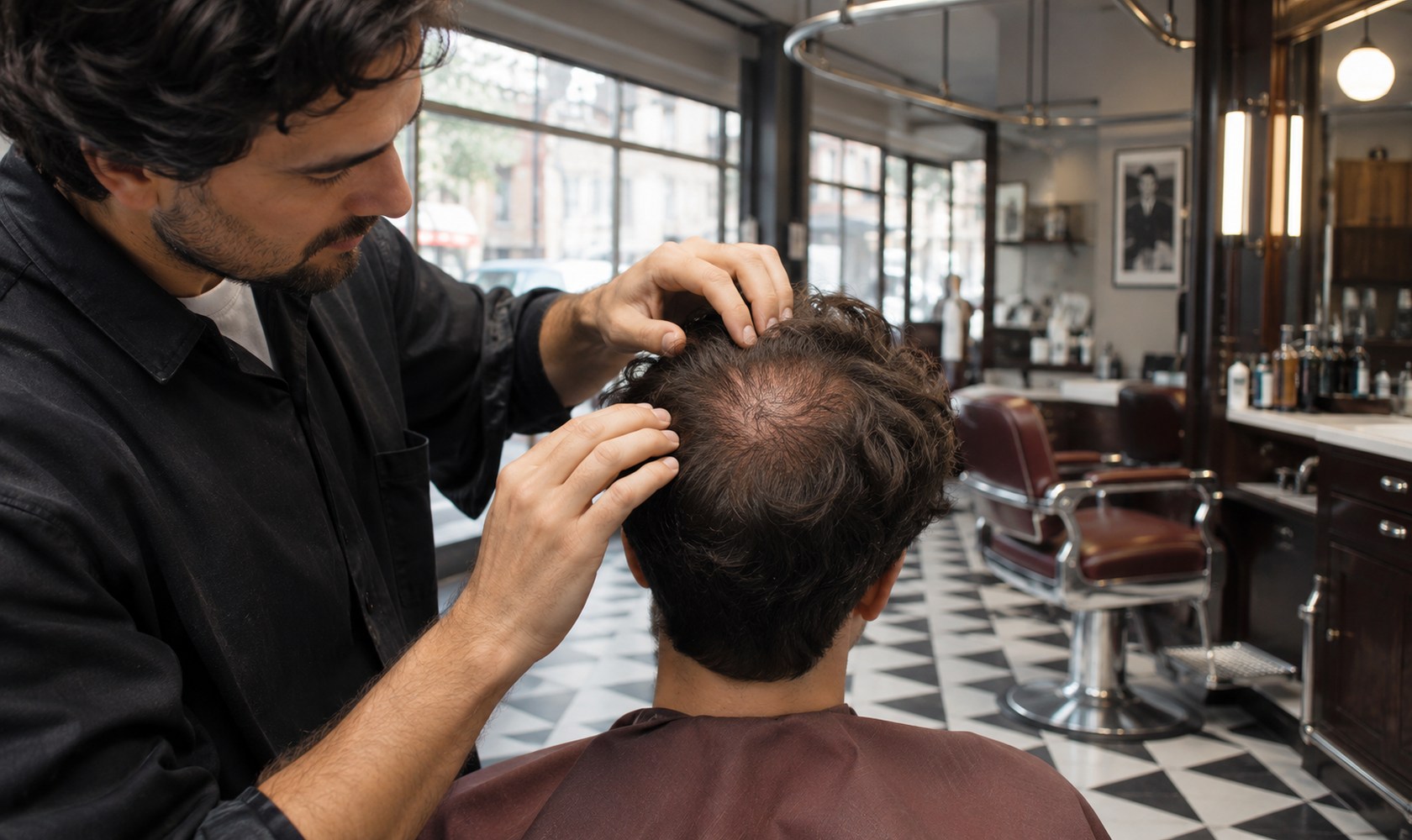
How DHT affects susceptible follicles
The body makes DHT from testosterone through an enzyme called 5-alpha-reductase. In genetically susceptible scalp follicles, androgen signaling contributes to miniaturization: the follicle produces progressively finer, shorter hairs, and the growth phase becomes shorter.
As thick hairs give way to thinner ones, the scalp can become easier to see. Different regions do not necessarily change at the same rate. Some men first notice the temples, while others notice a widening area at the crown.
Earlier treatment can help preserve hair before thinning advances, but it cannot guarantee complete regrowth. Long-standing bare areas may respond less well than areas that still contain miniaturizing hairs. Ask what treatment can reasonably preserve or improve in your particular pattern.
Other causes can occur alongside male-pattern loss
Telogen effluvium causes more follicles than usual to enter a shedding phase, often after an illness, operation, major stress, rapid weight change, or another disruption. Shedding may appear after a delay, so the trigger may not belong to the same week that you first notice hair in the shower.
Alopecia areata involves an immune process that attacks follicles and can create smooth patches. Fungal infection, inflammatory disorders, and scarring conditions can cause other patterns. These conditions do not all respond to finasteride or a nonprescription hair serum.
Nutrient deficiency can contribute to shedding when intake or absorption falls short. Iron or protein problems may matter in the right setting, but taking supplements without evidence of deficiency does not establish a treatment. Excess amounts of some nutrients can also cause harm.
Medicines, tight hairstyles, and repeated traction can affect hair too. Tell the clinician about new prescriptions, supplements, styling habits, scalp symptoms, and recent health changes. More than one contributor can exist at the same time.
What the Norwood scale describes
The Norwood scale gives clinicians a common language for the pattern and extent of male-pattern hair loss. It describes visible distribution rather than diagnosing the cause from a photograph or predicting exactly how fast your hair will change.
| Pattern stage | Typical appearance |
|---|---|
| Early stage | Little obvious loss or slight recession at the temples |
| More defined recession | Deeper temple recession, sometimes with an M-shaped frontal outline |
| Crown involvement | Thinning at the vertex, which can develop alongside a receding hairline |
| Advanced frontal and crown loss | Larger areas with a band of hair remaining between them |
| Joining areas of loss | The separating band becomes sparse or disappears |
| Most extensive pattern | A narrower band of hair remains around the sides and back |
The formal scale includes stages one through seven and variants. The stage-three vertex pattern emphasizes crown loss, while class A describes a less common progression of the frontal boundary toward the back. A dermatologist can interpret the pattern in context rather than forcing every scalp into a single sequence.
Photographs in consistent lighting can help record change. Use similar angles, hair length, and styling when comparing them. A wet scalp under bright overhead light can look different from dry hair in a dim room without reflecting a sudden change in follicle density.
What a hair-loss assessment may include
A clinician asks when loss began, whether it progressed gradually or suddenly, and whether relatives have a similar pattern. They examine the scalp, hair shafts, and affected areas and may use magnification to assess follicles and skin.
Testing depends on the history. Blood tests may help when symptoms suggest deficiency, thyroid disease, or another contributor, but not every man needs a broad hormone panel. A biopsy or other test may help when the diagnosis remains uncertain or scarring is a concern.
Bring a list of products and treatments you have tried, including dose, duration, and side effects. A few applications of a topical medicine do not count as the same trial as months of consistent use. Knowing the difference helps avoid labeling an effective option a failure too early.
Minoxidil supports growth while you keep using it
Topical minoxidil can help some men maintain hair or gain some density. Its full effect on hair growth is more complex than simply widening blood vessels, and not everyone responds. It cannot promise restoration of every area that has lost hair.
Follow the instructions for the actual formulation and apply it to the scalp rather than coating the hair. Irritation, itching, or unwanted hair growth away from the application area can occur. Ask how to manage early shedding or other changes instead of automatically increasing the amount.
Results take months to assess, and continued use usually matters for maintaining benefit. If you stop, the hairs supported by treatment can gradually become thinner or shed. Oral minoxidil is a separate prescription discussion with different risks; a topical product does not supply instructions for swallowing it.
Finasteride reduces DHT production
Finasteride inhibits 5-alpha-reductase and lowers DHT. Clinicians prescribe the oral hair-loss formulation for suitable men with androgenetic alopecia. It can slow progression and produce some regrowth, particularly when treatment starts before extensive loss.
Discuss sexual side effects, mood history, fertility concerns, breast changes, and other medical issues before treatment. Some people report symptoms that continue after stopping, so do not dismiss a concern simply because a short summary calls the medicine well tolerated.
The drug can also affect interpretation of prostate-specific antigen testing. Tell clinicians who arrange that testing that you take finasteride. Follow the prescribed strength instead of assuming that a higher-dose tablet for another condition offers a better hair treatment.
Finasteride and minoxidil can form part of the same clinician-directed plan, but combination treatment still needs clear instructions. Ask which change to expect, when to review results, and what symptoms should prompt earlier contact.
Transplant surgery moves hair rather than creating unlimited supply
Follicular unit transplantation, or FUT, usually involves removing a strip of donor scalp and preparing follicular units for placement. Follicular unit extraction, or FUE, removes individual follicular units. Both require planning around donor supply, the recipient area, and the likely future pattern.
A transplant can improve coverage in suitable patients, but it does not stop all remaining native hair from thinning. A surgeon may discuss ongoing medical treatment and the possibility of further procedures. Calling surgery permanent without explaining progressive hair loss can create unrealistic expectations.
Ask about scarring, recovery, complications, expected density, and who will perform each stage of the procedure. Review results from comparable patterns rather than relying only on a close-up photograph immediately after treatment.
Scalp care helps comfort but does not change every cause
Gentle washing and treatment of dandruff or inflammation can improve scalp comfort. Ordinary shampooing does not cause inherited baldness, and vigorous scrubbing does not revive miniaturized follicles. Choose care that you can tolerate rather than a routine that repeatedly irritates the skin.
Sleep, adequate nutrition, and support with stress can help general health and some triggers of shedding. They do not reliably stop genetic male-pattern hair loss. A man who continues thinning has not necessarily failed to manage stress or eat correctly.
Be cautious about products that promise to block every cause, reactivate dead follicles, or replace a transplant without evidence. Ask what type of hair loss the study involved and whether the marketed product matches the tested formulation.
Address the emotional effect without minimizing it
Hair loss may bring grief, frustration, embarrassment, or a sense of premature aging. Those reactions can matter even when the condition does not threaten physical health. You do not need to laugh it off or pursue treatment to satisfy someone else's expectations.
A support group, trusted friend, or counselor may help if concerns lead to avoidance or repeated checking. Hairstyles, shaving, concealers, and hair systems provide practical options alongside or instead of medical treatment. The choice can change over time.
Seek assessment promptly for sudden loss, scalp pain, inflammation, or signs of scarring. For gradual thinning, arrange a review while there is still a useful opportunity to discuss preservation, realistic results, cost, and the routine you want to maintain.
Sources
- American Academy of Dermatology. What is male pattern hair loss, and can it be treated?. https://www.aad.org/public/diseases/hair-loss/treatment/male-pattern-hair-loss-treatment
- DailyMed. Propecia - finasteride tablet. Prescribing information. https://dailymed.nlm.nih.gov/dailymed/drugInfo.cfm?setid=6f904709-65aa-44ce-b144-b4c8a0416e36
Related reading
- Hair Loss Treatment Options: Medicines, Procedures, and Daily Care
- Finasteride: Uses, Doses, Benefits, and Side Effects
- Health Guide
Medical Disclaimer: This content is provided for informational and educational purposes only and does not constitute personalized medical advice, diagnosis, or treatment. Always consult a qualified physician or licensed healthcare provider with any questions regarding a medical condition or prescription medication. Read our Editorial & Medical Review Policy.